
Heat is killing more Angelenos. UCLA is turning community health workers into a frontline of defense
As extreme heat becomes California’s deadliest climate threat, UCLA and Los Angeles County are training community health workers to serve as “heat ambassadors,” bringing life-saving information and resources directly to vulnerable residents. The LARC-HEAT program aims to build neighborhood resilience through trusted, person-to-person outreach.
Extreme heat is now California’s deadliest climate risk — triggering up to 1,500 additional ER visits a day in LA County during major heat waves and killing more residents each year than wildfires or floods.
While local governments expand cooling centers and shade infrastructure, Los Angeles is testing a different kind of heat defense: the people already checking on vulnerable residents behind closed doors.
LARC-HEAT—short for the Los Angeles Regional Collaborative: Heat Education, Ambassadors and Training—is a 30-month outreach initiative led by UCLA’s Institute of the Environment and Sustainability and the LA County Department of Public Health, in collaboration with more than 100 community partners.
Backed by a $3 million state grant, the summer of 2026 marks its last full season of door-to-door outreach in high-risk neighborhoods from Pacoima to Bell Gardens. In 2025, LARC-HEAT trained 124 health workers who attended over 80 events and interacted with more than 7,395 people.
“We are proud to support LARC-HEAT through the Regional Resilience Grant program. This effort demonstrates a comprehensive, partnership-driven approach that unites diverse voices and expertise to advance climate resilience at a regional scale. The project strengthens readiness across multiple fronts and offers a framework for heat practitioners and resilience leaders statewide,” said Dolores Barajas, Regional Resilience Grant Program Manager with the Governor’s Office of Land Use and Climate Innovation
Health care workers as climate infrastructure
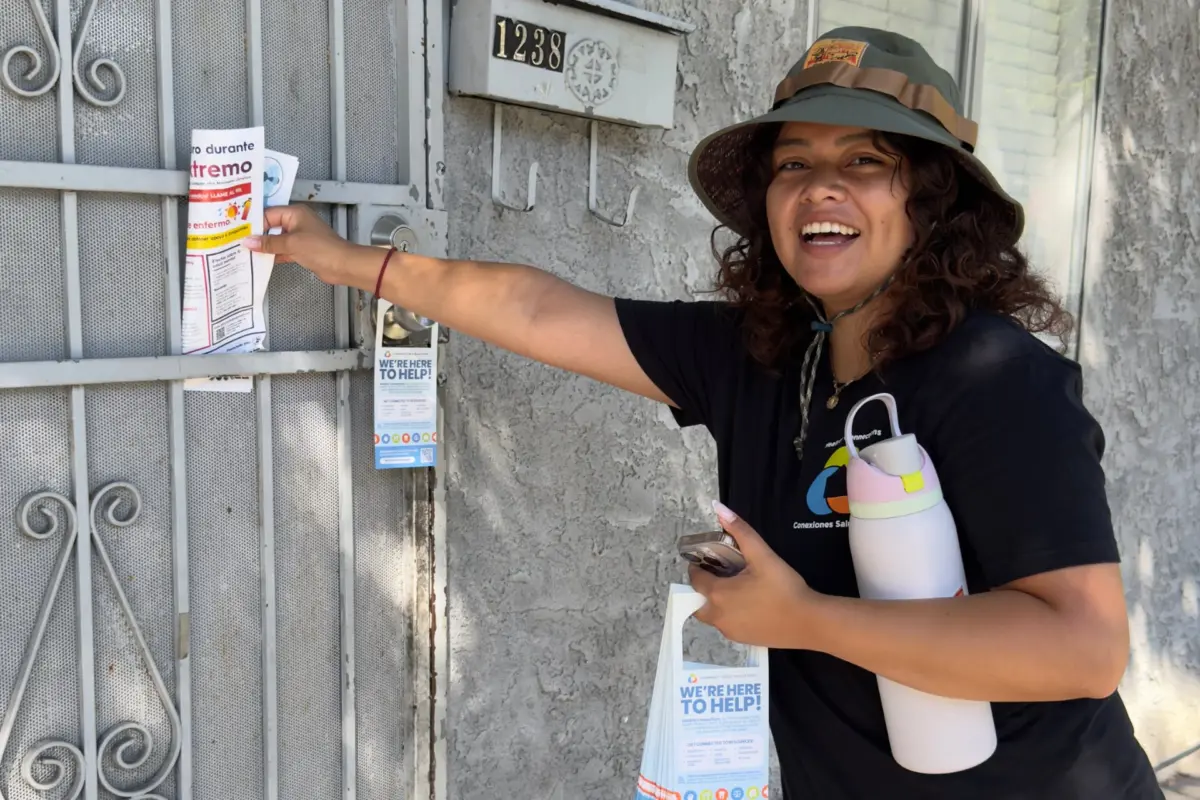
Community health workers—the same ones who conduct home visits to connect people to care and resources—have been trained as “heat ambassadors.” They learn how chronic illness and heat exposure interact and identify when dehydration could turn dangerous.
“Being out in the field, you see how fast high temperatures become dangerous,” said Kimberly, a community health worker in the San Gabriel Valley. “A lot of people don’t realize how much heat can affect their health and daily lives—or that it can be just as serious as other health emergencies.”
Heat Ambassadors serve as a layer of living climate infrastructure. Armed with extensive training on heat-health impacts, they mobilize when temperatures spike to equip residents with cooling towels, hats, and evidence-based flyers. By delivering this critical information and material support directly to the doorstep, they transform specialized knowledge into a public resource that strengthens the community’s collective defense against extreme heat.
The value of our trusted messengers
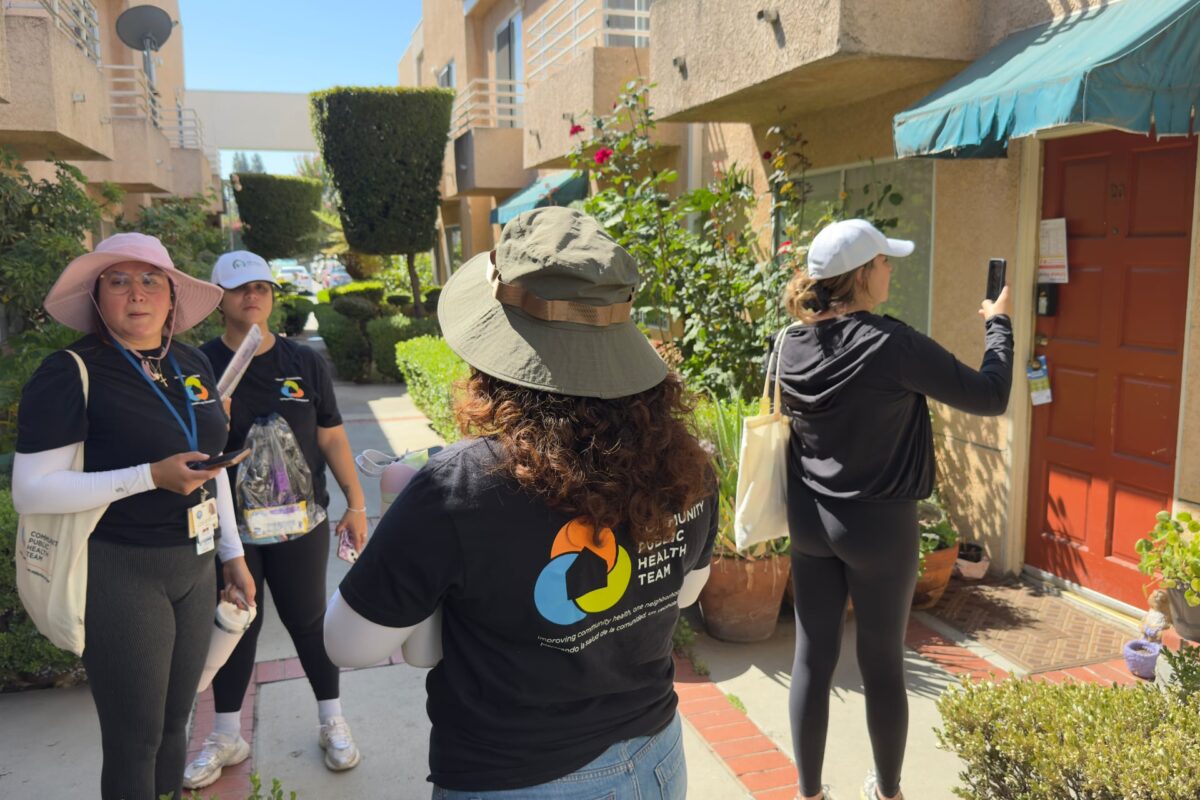
Community health workers conduct regular door-to-door home visits to connect underserved residents to local health clinics. That trust — built over years — is what is often missing in communities most exposed to heat. Workers say many residents silently endure sweltering conditions rather than risk debt, eviction, or unwanted attention from authorities.
“A man I spoke with in Rosemead told me he keeps the A/C on only for his dogs because they easily overheat—and that his electric bill is becoming almost too expensive to keep up with,” said Lucas Yoshida, another health worker in the San Gabriel Valley.
They also provide information on resources like energy assistance programs and the locations of nearby cooling centers.
“At a Senior Wellness Fair, we met an older man who didn’t know cooling centers were available,” said Alex, a heat ambassador with ECHO-San Gabriel Valley. “He lived alone with no A/C and thought he had no choice but to suffer through the heat. We gave him the information with cooling center locations. Later, he told us he went during a heatwave, and it really helped. That small conversation made a big difference for him.”
A scalable model
Between 2010 and 2020, roughly 3,900 Californians died from heat-related causes—about six times higher than official counts. More than 60% of those hospitalized are on Medi-Cal or Medicare. California has well-established emergency playbooks for wildfires and floods. But extreme heat—the state’s deadliest climate threat—doesn’t unfold like a traditional disaster, making it far harder to declare and respond to at scale.
Because LARC-HEAT is built around the public health workforce many counties already have, communities nationwide could adopt the model to scale climate resilience faster and at a lower cost than building new systems from scratch.
“The heat safety training developed for LARC-HEAT will be a valuable component of the LA County Heat Action Plan (CHAP) implementation, given its potential to be adapted and delivered to a variety of community service providers working with impacted populations,” said Ali Frazzini, Policy Director of the Chief Sustainability Office of Los Angeles County. “The County looks forward to leveraging this vital resource and supporting agencies across the region with doing the same.”
Small interventions with measurable impact
LARC-HEAT is designed to complement, not replace, long-term infrastructure.
“We need people and we need big infrastructure changes,” said Erin Coutts, executive director of Los Angeles Regional Collaborative. “This project focuses on the people.”
Because the program builds on existing health infrastructure, its cost is low—preventing a few dozen emergency admissions could effectively pay for the entire initiative.
According to Dr. David Eisenman, a physician and professor at the UCLA Fielding School of Public Health, Los Angeles still underestimates heat as a risk and is unprepared for dangerous heat events and preventable heat-related harm: “The assumption that we already know how to handle heat is one of the things most likely to get people killed.”
Investing in community-based solutions can keep people safe and deliver heat resiliency in our neighborhoods. The messengers matter as much as the message. Conversations provided by heat ambassadors not only strengthens resilience, but also empowers residents with the knowledge to protect their neighbors and families. Heat ambassador outreach builds a person-to-person safety net that can reach residents whom traditional systems may miss.
“People think of resilience as something you build,” Coutts said. “What we’re seeing is that it’s something you maintain—one person at a time.”
LARC-HEAT is supported by the Regional Resilience Grant Program implemented by the Governor’s Office of Land Use and Climate Innovation.
For more information about LARC, visit their page at: laregionalcollaborative.com. For extreme heat resources, visit HeatSafe.LA.