
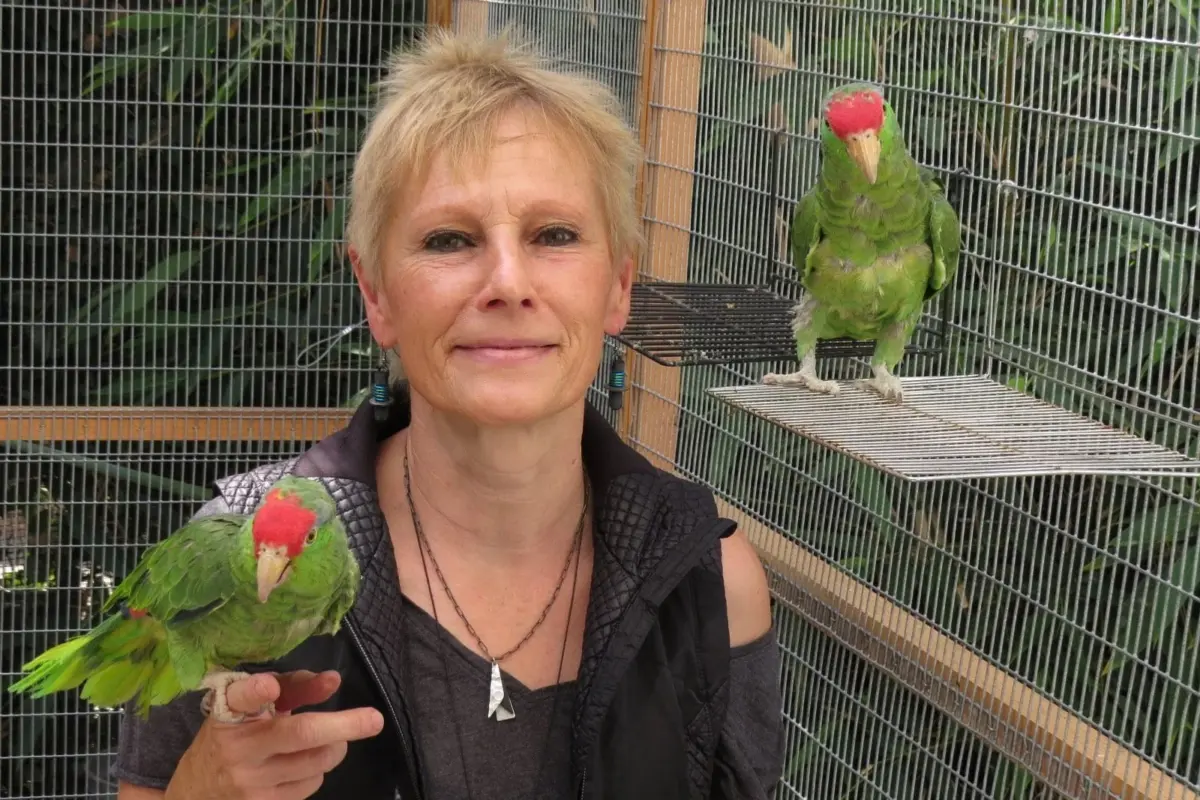
Environmental Science Needs the Humanities: IoES Prof. Ursula K. Heise Elected to the American Academy of Arts and Sciences
Ursula K. Heise, distinguished professor at UCLA with cross-appointments in the Department of English and the Institute of the Environment and Sustainability, has been elected to the American Academy of Arts and Sciences, the nation's oldest and most prestigious honorary society.
Ursula K. Heise, distinguished professor at UCLA with cross-appointments in the Department of English and the Institute of the Environment and Sustainability, has been elected to the American Academy of Arts and Sciences, the nation’s oldest and most prestigious honorary society.
The election places Heise among distinguished internationally recognized scholars. This election recognizes not only Heise’s individual career but also the growing influence of the environmental humanities, a field she helped establish through her work in connecting literature, ethics, and environmental studies.
“Being in the Academy of Arts and Sciences and being able to be a spokesperson means to me that the value of the approach and the importance of the environmental humanities are being recognized,” she said.
An Interdisciplinary Approach
For decades, experts from scientists to economists to political scientists have worked to bring change to how humans systematically interact with the natural world. Yet global temperatures continue to rise, species disappear, and environmental degradation accelerates.
Heise’s work offers a new lens to see through, emphasizing that environmental crises and solutions are shaped not only by science and economics but also by cultures, values, and narratives.
“Take climate change as an example,” Heise said. We already possess many of the technologies, resources, and policy tools needed to address climate change. Still, we just aren’t doing it, despite a half-century of knowledge about the severity and tragic consequences it will have.
The human dimension is what remains harder to solve: why people resist change, delay action, and continue to organize our economies around destructive priorities.
To find the answer, Heise points to “questions of cultural history and basic questions of value.” Different societies understand nature in different ways. Throughout her career, Heise’s research has taken a comparative approach. She examines how environmental issues are understood across cultures, from her home country of Germany to North America, Latin America, and regions across Asia. Her research reflects that environmental challenges cannot be understood through a single cultural lens.
Some traditions view animals as sacred and sentient beings; others emphasize reciprocal relationships between people and the elements. Many see no other living things or systems, except for humans, as a priority for protection. These differing world views shape how communities define progress, responsibility, and ultimately environmental policy.
Recognizing this gap, Heise’s work was motivated towards building the environmental humanities. She recalls that researchers and activists thought that “environmental processes and environmental change were problems for sciences and engineering, not for humanities… it took convincing” to get scholars in her own field and other fields to accept that the humanities should have a place in environmental knowledge.
Today, Heise sees UCLA’s Institute of the Environment and Sustainability as a model for that collaborative future. Since joining UCLA in 2012, she says she has felt that the university recognizes that many of the 21st century’s pressing issues “need to be approached interdisciplinarily.”
Power of Storytelling
A central theme in Heise’s work is the role that storytelling plays in the way we view reality. Drawing on narrative theory, she argues that societies rely on default narratives, or “masterplots”, to understand the systems that shape our lives.
Masterplots are familiar storylines that people use to engage with complex events, fitting those events into recognizable narrative patterns. Public reactions to crises often depend on which masterplot those crises fit into, and whether it’s an existing masterplot people already understand.
Heise offered a classic example: Silent Spring, the 1962 landmark book by Rachel Carson that transformed how the public understood toxic chemicals and their impact on the environment. By linking the harms caused by pesticides to narratives—and anxieties—people already had about nuclear fallout, the book helped reshape public perception of dangerous toxins and motivated support for environmental reforms.
Heise explains, “certain storytelling patterns are used to make unknown environmental problems, processes, and crises known to the general public.”
Environmental Justice for All
Heise also explores how questions about environmental justice have expanded beyond issues of pollution and resource access. Increasingly, she asks whether justice should stop at the human border or extend to other species and ecosystems.
In her book, Imagining Extinction: The Cultural Meanings of Endangered Species, published in 2016, Heise examines how biodiversity loss and species extinction are cultural issues, shaped by stories about which species matter and why they deserve protection. Endangered or extinct animals can become powerful symbols of what modernization and colonization have erased.
Heise argues that some species gain visibility because they become tied to collective memory and identity. The endangerment and extinction of culturally revered animals can motivate policy changes to preserve them. Simultaneously, it reveals a gap between what humans value symbolically and protect in practice.
The animals—only more rarely plants—that become part of public concern over conservation are typically ones that form part of the stories that particular countries or communities tell about their own ecological and cultural losses. They tend to be stories about how the identity of a community changed.
This is true of many environmental conservation efforts. For example, sea turtles are not the only marine animal affected by anthropogenic environmental destruction, but they have become the poster species for their ecosystem and for efforts to protect that ecosystem.
While this offers a vehicle for conservation policy, it also poses the question: how many animals have we forced into extinction that we don’t even think about? Thousands of less “charismatic” species disappear with little public attention, despite their ecological importance, revealing how unevenly humans assign value within the natural world.
For Heise, this proves the need to increase research on how environmental issues are understood, because human perspectives inevitably shape our conservation choices.
If our most urgent issues from climate change to biodiversity loss are a crisis of values as much as they are science, then we must widen the framework through which we approach solutions.
Heise’s election to the American Academy of Arts and Sciences honors more than a distinguished career; it signals an expansion of how environmental issues can be understood.