
Morton La Kretz
Morton La Kretz is a real estate developer and the founder of Crossroads Management, a property management company managing a portfolio of industrial, commercial and residential properties throughout the Los Angeles basin. Crossroads of the World, a historic landmark in Hollywood built in 1936, is the most well known of these properties. Morton began his career in the early 1950’s, first working for contractors but quickly striking out on his own.
Morton’s philanthropic work focuses on education, the environment and conservation. Among those works of which he is most proud are: the La Kretz Innovation Campus at the Los Angeles Cleantech Incubator; UCLA’s La Kretz Hall, which is the first building at UCLA to receive accreditation under the LEED Green Building Rating System and houses the Institute of the Environment; the UCLA La Kretz Garden Pavilion; Cal State L.A.’s La Kretz Hall of Sciences; and the La Kretz Watershed Garden at TreePeople headquarters, providing a visual environment in which children can learn about water conservation.
Morton considers himself a true L.A. native, having lived here virtually all of his life and spending considerable time getting to know its neighborhoods, architecture and history. He holds a B.A. degree from UCLA.
Brenda Larison
Research Interests
I am fascinated by the myriad of physical forms and behaviors that animals display. In my research I focus both understanding how this amazing diversity evolves, and how to conserve it. My current research addresses both evolution and conservation through work the two projects below. I work in the lab of Bob Wayne here at UCLA, with researchers here in CTR, and with colleagues at several other institutions in the U.S. and abroad.
How the Zebra Got Its Stripes
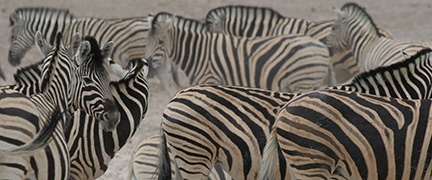
How zebra evolved stripes is a mystery. It seems like there must be an advantage to offset how conspicuous they seem, but what is it? What are the genetic changes that occurred to cause striping? I’m working with my colleagues to find the genes that control striping and to discover what advantages there might be to stripping. Finding the genes that control striping can tell us a lot about how stripes evolved and why. Because natural selection leaves a footprint on the genome, genes can tell us whether they confer an advantage or not. Because of this we can map both genetic and stripe variation and compare this to geographic variation in environmental factors that we think may be important. Are zebra more striped in areas with higher temperatures, more trees or more tsetse flies? If they are this will lead to hypotheses that we can test more directly.
Insights from Genetics and the Conservation of Grevy’s Zebra
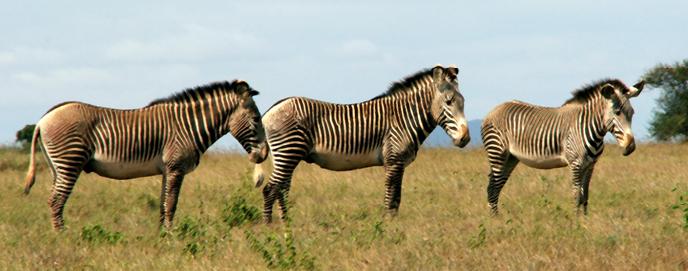
The endangered Grevy’s zebra is the largest and most finely striped of the three species of zebra. Less than 3000 remain in the wild concentrated in the ecologically rich Laikipia-Samburu region of Kenya. They are a flagship species, the preservation of which will help maintain the essential ecological processes that have created ecosystems like the Laikipia-Samburu. Our research on Grevy’s examines how human land-use influences population genetic structure, migration, and gene flow using genetic tools, collaring data and modeling. Because we work closely with conservationists and managers, they can use our results to determine what management actions are required and how best to work with the local communities to conserve this species.
Education
Ph.D. University of California, Los Angeles, 2007
MA Biology, San Francisco State University, 1996
BS Marine Biology, San Francisco State University, 1989
Teaching
Lecturer in the Department of Ecology and Evolutionary Biology, UCLA
EEB114 Ornithology
EEB129 Animal Behavior
EEB124 Field Ecology
Publications
Cordingley J. E., Sundaresan S. R. Larison, B. J., Shapiro, B., Rubenstein, D. 2009. Grevy’s zebra conservation: overcoming threats of isolation, genetic hybridization and demographic instability. Animal Conservation 12:520-521.
Larison, B. 2008. Impacts of environmental heterogeneity on alternative mating tactics in the threadtail damselfly. Behavioral Ecology and Sociobiology 16:531-536.
Larison, B. 2007.Environmental heterogeneity and alternative mating tactics in the damselfly, Protoneura amatoria. Behavioral Ecology 18:1021-1028.
Larison, B., P. W. Williams, S. A. Laymon, and T. B. Smith. 2001. Avian responses to restoration: nest-site selection and reproductive success in Song Sparrows. Auk 118:432-442.
Smith, T. B., K. Holder, D. Girman, K. O’Keefe, B. Larison, and Y.Chan. 2000. Comparative avian phylogeography of Cameroon and Equatorial Guinea mountains: implications for conservation. Molecular Ecology 9:1505-1516.
Larison, B., T. B. Smith, R. Fotso, and D. McNiven. 2000. Comparative avian biodiversity of five mountains in northern Cameroon and Bioko. Ostrich 17:269-276.
Schneider, C. J., T. B. Smith, B. Larison and C. Moritz. 1999. A test of alternative models of diversification in tropical rainforests: Ecological gradients vs. rainforest refugia. Proc. Nat. Acad. Sci. 96: 13869-13873.
Larison, B., S. A. Laymon, P. L. Williams, and T. B. Smith. 1998. Song Sparrows vs. Cowbird brood parasites: impacts of forest structure and nest-site selection. Condor 100: 93-101.
Kristine Kaiser
Karen Kapheim
J. Patrick Kelley
Margaret Kinnaird
Alexander Kirschel
Michael Kohn
Sirena Lao
As the laboratory technician at the Center for Tropical Research, Sirena conducts lab work using molecular techniques to assist with various studies, such as migratory connectivity of songbirds and adaptive variation in African wildlife. She also manages the Center’s extensive feather sample collection and ensures that the lab is running smoothly. Sirena is an alumna of the IoES Environmental Science undergraduate program and is broadly interested in wildlife conservation and the management of ecosystems and natural resources.