Dr. Federico was previously the Executive Director of the California Center for Sustainable Communities at UCLA. She is responsible for advancing all aspects of CCSC work, including research initiative conceptualization, proposal writing, interdisciplinary project management, and strategic partnership development. Current research projects include grants from the California Energy Commission, California Strategic Growth Council, Los Angeles Department of Water and Power, and the County of Los Angeles (for the first Los Angeles County Sustainability Plan). She also collaborates with the UCLA Sustainable Los Angeles Grand Challenge and serves as lead technical author on the Sustainable LA Environmental Report Cards for Los Angeles County.
Dr. Federico’s experience includes work in the private sector (aerospace, petroleum) as well as consulting, prior to academia. Her interdisciplinary education combines expertise in engineering and environmental sciences with an understanding of the legal, policy, economic and social science elements critical to addressing complex environmental challenges.
Focus areas include: energy, water, climate change / sustainability planning, and environmental equity.
Education
- University of California, Los Angeles: Doctorate, Environmental Science and Engineering
- University of California, Los Angeles: M.A., Geography
- Rensselaer Polytechnic Institute, Troy, N.Y.: B.S., Mechanical Engineering
Selected Reports and Publications
- Porse, E., Fournier, E.D., Cheng, D., Hirashiki, C., Gustafson, H., Federico, F., Pincetl, S. Prioritizing the Locations of Urban Rooftop Solar Energy Resources. Energy Policy, In Review.
- Fournier, E.D., Federico, F., Porse, E., and Pincetl, S. Effects of Building Size Growth on Residential Energy Efficiency and Conservation in California. Applied Energy, Volume 240, 15 April 2019, Pages 446-452.
- Gold, M., Federico, F., Rauser, C.L., 2019 Sustainable LA Environmental Report Card for Los Angeles County: Water. In Preparation.
- Federico, F., Pincetl, S., Fournier, E.D., Porse, E., Chuang, Y., Delmas, M., Williams, R., Perkins, C., Costa, M., Diaz., D. 2018. Accelerating AEC Deployment around Existing Buildings in Disadvantaged Communities through Unprecedented Data Analysis and Comprehensive Community Engagement. California Energy Commission. Publication Number: CEC-500-2019-010.
- Federico, F., Rauser, C.L., Gold, M., 2017 Sustainable LA Environmental Report Card for Los Angeles County: Energy and Air Quality.
- Federico, F., Mazor, R., Lee, L., Ostermann-Kelm, S. 2019. Protocol implementation plan for monitoring stream condition in the Mediterranean Coast Inventory and Monitoring Network of Southern California. Natural Resource Report NPS/MEDN/NRR—2019/1875. National Park Service, Fort Collins, Colorado.
- Willis, K.S., Ostermann-Kelm, S., Federico, F., Lee, L., MacDonald, G.M., Gillespie, T.W. 2018. Protocol for monitoring landscape dynamics in the Mediterranean Coast Network of southern California. Natural Resource Report NPS/MEDN/NRR—2018/1830. National Park Service, Fort Collins, Colorado.
- Gold, M., Pincetl, S., and Federico, F., 2015. 2015 Environmental Report Card for Los Angeles County. http://www.environment.ucla.edu/reportcard/
- Federico, F., S. Ostermann-Kelm, C. Brigham, and P. Bunje. 2012. A collaborative science agenda on climate change for Southern California coastal national parks. Natural Resource Report NPS/MEDN/NRR—2012/583. National Park Service, Fort Collins, Colorado.
- Stein, E.D., Federico, F., Booth, D.B., Bledsoe, B.P., Bowles, C., Rubin, Z., Kondolf, G.M., Sengupta, A., 2012. Hydromodification Assessment and Management in California. Southern California Coastal Water Research Project Technical Report 667, April 2012.
Our research program focusses on how biodiversity and ecological integrity are impacted by various perturbations resulting from landscape changes during the anthropocene epoch. We focus on southern California and on islands throughout the Pacific Basin, and study a variety of non-marine taxa. We utilize a broad range of tools, from molecular genetics to field ecological surveys, to investigate ecological and evolutionary responses of these systems. For the most part our research is has a strongly applied component, and managers can and do utilize our results in their decision processes. In some cases basic taxonomy is required to determine levels of species diversity and biodiversity, and for these studies we incorporate morphological and genetic analyses. Other investigations carried out by our team focus on how natural and anthropogenic landscape features impact biodiversity. Recently we have worked extensively on ecosystem level-perturbations which include removal of invasive species from islands (i.e. rats in the Pacific) and large-scale fires in southern California, and how these systems respond to such catastrophic modifications. We also spend a considerable amount of time and energy monitoring species utilizing occupancy modeling approaches, particularly for cryptic and/or rare taxa. We have developed movement models (2-D and 3-D) utilizing individual-based models for species parameterized with high resolution (spatial and temporal) GPS tracking to assess responses of species to modern and alternative future landscapes, to inform planners in an effort to reduce future connectivity or alternative energy conflicts.
My research is at the intersection of community and ecosystem ecology and my overarching goal is to use basic knowledge gained from this research to inform conservation of habitats and communities in the face of a changing world. Over the last 30 years, a vigorous debate has developed in ecology which concerns one of the most basic conceptual models of our time, namely whether communities are structured by forces from the top (consumers) or the bottom (resources) or as a result of the interactions between these forces. What gives this question critical new importance is the widespread occurrence of rapid and catastrophic phase shifts that have been associated with human alterations of top down and bottom up forces.
My students, collaborators, and I are conducting research at the forefront of this critical area, which has relevance not only to ecologists, but also to those concerned about the effects of climate change, alteration of biogeochemical cycling, and accelerating human use of natural resources. Specifically, my research seeks to further our basic understanding of how the relative strength of and interaction between top-down and bottom-up processes shape communities. Further, and perhaps most importantly, we ask why their relative importance varies across different coastal marine communities.
Research Interests
- Agricultural and Forest Entomology
- Effects of Soil Macrofauna on Soil Fertility
- Pests Management
- Avian Diseases
Current Research Projects
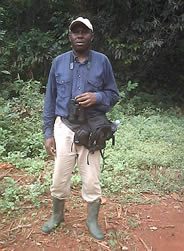
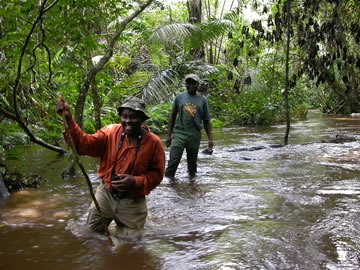
The current research projects with which I am involved through the Center for Tropical Research include:
- Sampling domestic and wild birds for the Avian flu virus and other bird diseases and pigs for the Swine flu virus in Cameroon.
- Sampling domestic and wild bird communities across a range of agricultural and natural habitats in the Far North Province of Cameroon during critical winter season when long distance palearctic migratory birds are present to determine Avian influenza prevalence
- Looking at the relationship between bird species, vegetation type and habitat in cocoa plantations in Southern Cameroon.
- Collecting blood, cloacal and tracheal samples and morphometric data from both wild and domestic birds for DNA and RNA analysis and screening.
- Radio-tagging Hornbills in the Kompia Community Forest in the periphery of the Dja Biosphere Reserve to monitor their migratory patterns in the Congo BasinRain Forest.
- Surveillance of the Swine Influenza Virus, H1NI and other swine
diseases in Cameroon.
Professor Froines joined the faculty of the School of Public Health in 1981. He received a B.S. in chemistry from UC Berkeley (1963), M.S. in chemistry (1964) and Ph.D. in physical-organic chemistry (1967) from Yale University. He conducted postdoctoral research at the Royal Institution of Great Britain under Nobel Laureate, Sir George Porter from 1966-68. Before coming to the UCLA School of Public Health, Dr. Froines was Assistant Professor of Chemistry at the University of Oregon and later served as Director of Toxic Substances at the Occupational Safety and Health Administration and Deputy Director of the National Institute for Occupational Safety and Health. Dr. Froines served as the Director of the Center for Occupational and Environmental Health for 25 years and is currently the Director of the Southern California Particle Center and Supersite. He is Associate Director of the Southern California Environmental Health Sciences Center and the Director of the UCLA Fogarty Program in Occupational and Environmental Health. He is Director of the Sustainable Technology and Policy Program. He serves on three advisory committees of the South Coast Air Quality Management District. Dr. Froines’ area of expertise is toxicology and exposure assessment. His research interests are in the qualitative and quantitative characterization of risk factors in environmental and occupational health.
Dr. Froines chairs the State of California’s Scientific Review Panel; the central review panel at the State level for identifying toxic air contaminants.
