
Cully Nordby

Dr. Cully Nordby is the Associate Director of the UCLA Institute of the Environment and Sustainability. She has devoted her career to educating and empowering students to summon the future they seek. She was instrumental in building the Institute’s academic program from one undergraduate minor to a full suite of programs including a B.S. in environmental science, two doctoral programs, and the Leadership in Sustainability graduate certificate.

Cully served as chair of the UCLA Sustainability Committee (2008-2016) and urged the campus to embrace its role as a living laboratory. She created UCLA’s Sustainability Action Research program in which students from across campus work in small teams with administrators to research how to make the campus more sustainable. Believing that we must get past the narrative of doom and gloom, Cully has inspired hundreds of University of California faculty to embrace the message that an equitable, healthy, and sustainable future is achievable. In service to the ambitious UC goal of being carbon neutral by 2025, she developed and launched faculty curriculum workshops which led to thousands of UC students across a broad array of disciplines taking courses infused with climate change and sustainability concepts. She has also taught in the Freshman Cluster program for over 12 years. Currently, her passion is transforming UCLA’s beautiful Sage Hill into an outdoor learning space, providing hands-on, meaningful teaching and undergraduate research opportunities for students in all fields.

Cully earned a B.S. in zoology from the University of Wisconsin-Madison and a Ph.D. in animal behavior, as well as a graduate certificate in conservation biology, from the University of Washington. While doing postdoctoral research at UC Berkeley in behavioral ecology and conservation biology she held a David H. Smith Conservation Research Fellowship.

Cully also believes in the power of engaging as a citizen and volunteered for six years on the sustainability committee for the Culver City Unified School District where she helped the district win a national Green Ribbon School award from the U.S. EPA.
Sergey Nuzhdin

Gabin Nzamba

Gregory Okin

Greg Okin is a Professor in the Departments of Geography and the Institute of the Environment and Sustainability, and currently serves as Chair of Geography.  He received his PhD from Caltech in 2001 and has been at UCLA since 2006. Professor Okin’s main research interests concern plant-soil-atmosphere interactions in the world’s drylands, which cover 40% of the Earth’s land surface. Because atmospheric dust mainly comes from drylands as a result of these interactions, mineral aerosols form a key theme of his work. His research takes place in the US and abroad, with laboratory, field, and modeling components.  His research also makes heavy use of remote sensing analysis, both in method development and process studies.  One active project examines the impacts of wind erosion in driving the conversion of grassland to shrublands, a phenomenon observed in drylands worldwide. Another concerns using cloud computing to monitor rangelands through combining satellite and field data.

Education

  • Postdoctoral Research, Department of Geography, UCSB (2001-2002)
  • Ph.D., Geochemistry, California Institute of Technology (2001)
  • M.S., Geology, California Institute of Technology (1997)
  • B.A., Chemistry & Philosophy (Double Major), Middlebury College (1995)

Research Interests

My research focuses on the geomorphology, soils, and vegetation of arid and semiarid lands at scales ranging from meters to regions. One theme that I emphasize in my research is aeolian geomorphology, due to its importance in understanding desert landscape dynamics and because dust emission from deserts produces mineral aerosols that strongly influence downwind ecosystems and impact the Earth’s climate. Another major theme of my research is the interaction between soils, vegetation, and climate in deserts. I conduct field and laboratory research and employ remote sensing and spatial modeling to understand fine-scale processes, meso-scale patterns, and global-scale Earth system interactions. My research program reflects my interest in fundamental questions of scale that transcend disciplinary boundaries: how do physical, chemical, and biological processes act across landscapes to produce observed environmental patterns and how, in turn, do these patterns modulate large-scale spatial and temporal interactions within the Earth system?


Adán Oliveras de Ita

Research Interests

I am interested in the historical and current factors that modify biological diversity and determine its distribution patterns. I am also interested in the natural history and evolution of bird life histories with respect to their breeding biology.

Current Research Project

Assessment of the genetic variability among and within the remnant populations of the Mexican endemic Sierra Madre Sparrow and of its current distribution, with the aim to facilitate the development of adequate conservation plans for this endangered species.

Paul Ong

Professor Ong has done research on the labor market status of minorities and immigrants, displaced high-tech workers, work and spatial/transportation mismatch, and environmental justice. He is currently engaged in several projects, including an analysis of the relationship between sustainability and equity, the racial wealth gap, and the role of urban structures on the reproduction of inequality.

Previous research projects have included studies of the impact of defense cuts on California’s once-dominant aerospace industry, the impact of immigration on the employment status of young African Americans, and the influence of car ownership and subsidized housing on welfare usage.

Dr. Ong is the Director of the Center for Neighborhood Knowledge and editor of AAPI Nexus, and has served as an advisor to the U.S. Bureau of the Census, and to the California Department of Social Services and the state Department of Employment Development, as well as the Wellness Foundation and the South Coast Air Quality Management District.

He received a master’s in urban planning from the University of Washington, and a Ph.D. in Economics, University of California, Berkeley. Along with his quantitative research, his professional practice includes teaching and applying visual forms of communication.

Frederic Paik Schoenberg

I am a Professor of Statistics at UCLA, and was chair of the department from 2012-2015 and vice chair from 2006-2012. My research focuses on spatial-temporal point processes, and their applications especially to the study of earthquakes, epidemics, wildfires, and crimes. I am also the founder and editor of the Journal of Environmental Statistics and Associate Editor of the Annals of Applied Statistics. I received my Ph.D. in Statistics, University of California, Berkeley and B.S., Mathematics, Honors and Magna cum Laude, Brown University.


Akane Nishimura

Research Interests

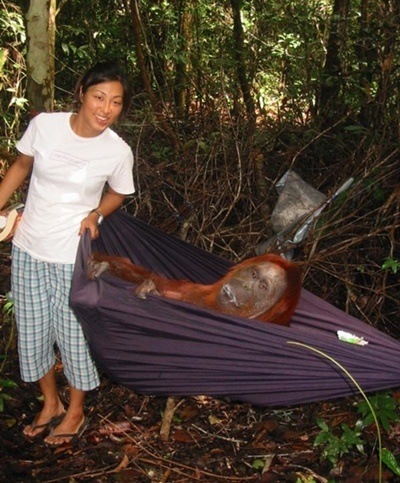
Lowland tropical rainforests are rapidly disappearing due to fire, logging, and agriculture. Research and restoration efforts are urgently needed, especially in understudied and underserved areas like Borneo. Borneo is the world’s third largest island and is part of the Sundaland Biodiversity Hotspot. It is also home to many endangered species, including orangutans.

akane nishimura

Natural succession and restoration efforts in Borneo have been affected by the invasive grass Imperata cylindrica, which is considered to be one of the ten worst weedy species in the world. Imperata is indigenous to Asia, but has recently expanded into disturbed rainforests throughout Southeast Asia, including my study area in Tanjung Puting National Park in Central Kalimantan (Borneo, Indonesia).

The goal of my research is to assess natural and assisted successional patterns in an effort to develop feasible, large-scale restoration of Imperata grasslands to secondary forest. As deforestation rates increase and El Niño related droughts in the area become more frequent and severe, it is essential to predict and prevent further degradation. To these ends, I am using a variety of techniques, including establishing a chronosequence of plots, root exclusion experiments, seed bank experiments, Geographic Information Systems (GIS), and remote sensing.

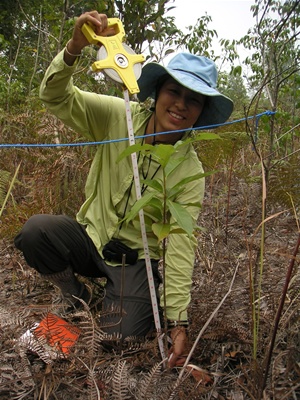
During the fall of 2006, I established a series of 10×10 m plots in areas with different use and fire histories. This work is being done with the aid of a local non-governmental organization (NGO), Friends of the National Park Foundation (FNPF). Some plots have been planted with native trees to determine what effects restoration has on early post-fire succession. We measured changes in understory plant cover, diversity, and recruitment as indicators of succession. I have also established two larger plots to conduct root-exclusion experiments, which will elucidate the role of underground competition in early succession.

Since fire has become prevalent in this area, I am also field validating the accuracy of several fire products for Central Kalimantan. This involves recording the presence or absence of fires based on field observations and comparing this to remotely sensed data. During future field seasons, I will continue to monitor my permanent plots and use remote sensing to analyze patterns in fire frequency, climate, and land cover change.

akane nishimura


John Novembre

Tim O’Brien