Giving voice to biodiversity at the decision-making table
2026 Pritzker Award finalist Zuzana Buřivalová reflects on her work
My first week doing fieldwork in a tropical forest was a sleepless one: The semester before, I’d studied how to identify the plants of Madagascar at the University of Geneva, but then it came to long days of walking through the Andrafiamena tropical forest, collecting all plants that were flowering or fruiting to create a species list for a new community protected area. For each one, I would attempt to match the features I’d memorized with the real fruits, flowers, and the smell, shape and latex of the leaves.
At night, my mind would rush through the plants, over and over, getting stuck and unstuck, until finally falling asleep. Even then, I had dreams of my tent overflowing with specimens that I was trying to keep dry between sheets of Malagasy newspapers and corrugated iron. The following months in Madagascar were hard: sickness, lack of food, flooding and isolation took their turns. But from day one, it was clear that I had been right about what was “the most interesting thing in the world” to me: studying and protecting tropical forests.
Perhaps this interest was due to growing up in a small Czech village surrounded by forests, and going to these forests every day instead of playing with others after school. Maybe it came with the overly vivid imagination of a six-year-old looking at — no, being inside of — the 20-year-old foldout rainforest book illustrated by the phenomenal Vojtěch Kubašta. Or maybe it was seeing logging in some parts of our village’s forest and feeling as if it were naked afterwards, with all its mystery lost with each clearing. Driven by my “whatever it takes” stubbornness, I eventually left my country at age 16 to finish high school in the UK, staying there to study biology at Oxford, and later doing graduate degrees in Switzerland with research in Madagascar.
I still think a lot about logging, and have now stood in many more clearings, like freshly logged forests in Gabon, Indonesia, Peru and the USA, and in places where entire forests are gone, replaced with agriculture; not to feed local people, but to follow “rational decisions” about profits made somewhere far away. I often question the meaning of the word “rational,” when a forest is shrinking so quickly that the hundreds of plant species that all look so different from each other (in addition to the lemurs, chameleons, the fossa and invertebrates that look like multi-colored mini-dinosaurs) are actually disappearing, in the sense that the last individual in the world dies with no seeds, no babies, not even a lone specimen in a botanical garden somewhere.
How is it not enough to simply say “these species exist” for the world to rationally want to do everything it can to protect them? Would more people agree to this rationale if they had the relevant information, if they could see, hear, smell and understand those plants and animals when they are making such decisions?
About 15 years later, during the pandemic, I was reminded of my initial mental overwhelm from experiencing the plant diversity of Madagascar. During those long days of lockdown, I worked to document every single sound in a 24-hour sequence of tropical forest soundscape I had recently recorded in East Kalimantan, Indonesia. There were hundreds of different kinds of sounds, some heard 256 times, others just once during the entire day. Some dominated the soundscape, like the interlocking chorus of empress cicadas, and others just managed to fit in between gibbons singing.
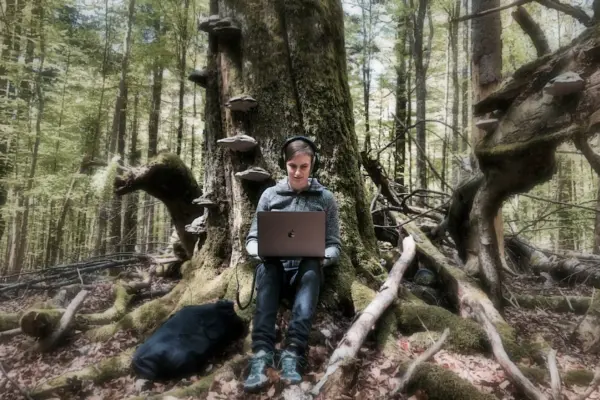
I would play short segments of the soundscape on loop, to be sure which sound was which, and mark on my laptop exactly when each sound starts and ends. Why? Yes, I missed working in tropical forests during that time — but also I couldn’t help it — I couldn’t help trying to learn all that can be learned from a soundscape.
At night, I would still hear these sounds while falling asleep, categorizing and replaying them in my mind until feeling exhausted and overwhelmed, but also remining fully convinced that experiencing, studying, and protecting tropical forest biodiversity is not only “the most interesting thing” but also “the most important thing” that I could do with my life.
I don’t make decisions about the fates of forests, but I work to ensure that the people making such decisions hear their biodiversity, loud and clear. Through recording entire forest soundscapes, I also make time capsules of what the world’s remaining old-growth forests are like, complete with their mysteries and familiar and unknown species, before any clearings are made, and before the heat takes hold.
This helps decision-makers design better logging and reforestation programs, and it supports local communities in showing to the broader world that their ways of protecting their forests work. Until biodiversity has a non-negotiable right to existence, I will work to give it a voice at the decision-making table through sound science.
Meet the Author