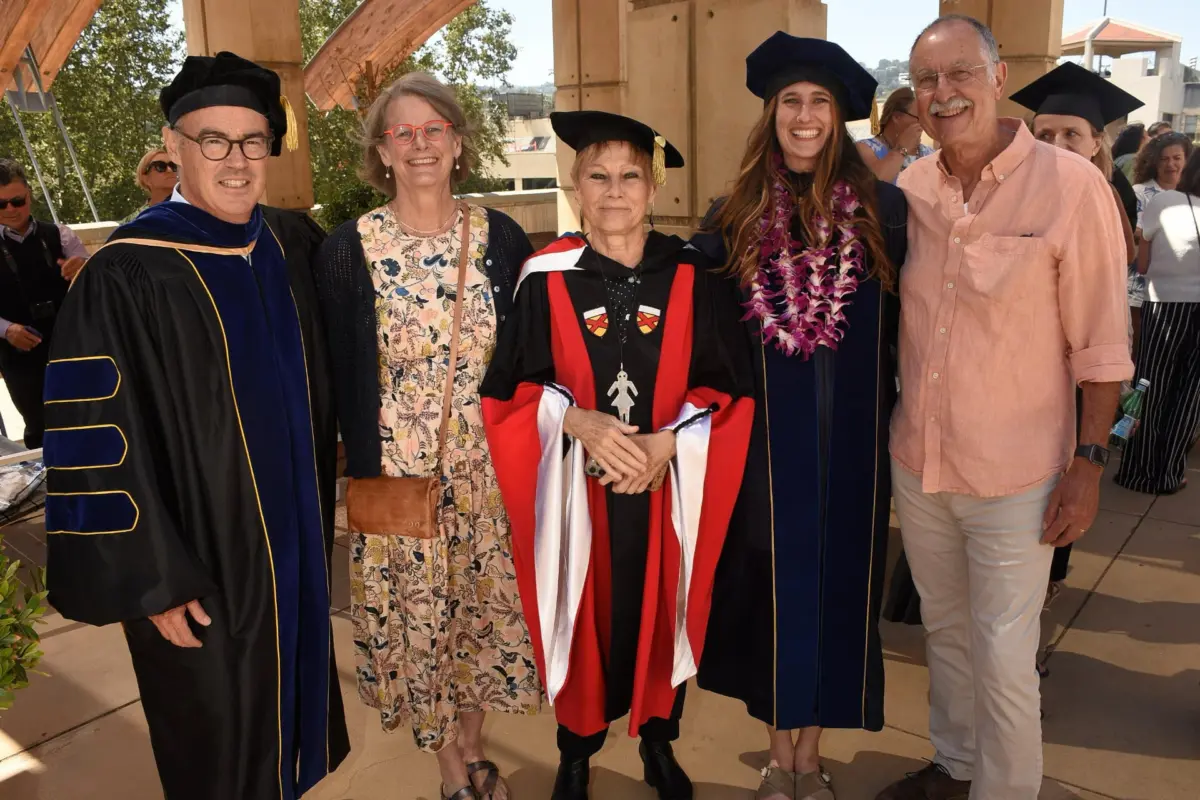
PhD Graduate Highlight: Emma Barnosky looks at the social and political dimensions of fire management
Emma Barnosky's PhD research at UCLA explores the human side of wildfire, examining how Californians experience, understand, and recover from increasingly destructive fires.
This June, Emma Barnosky graduated with a PhD from the UCLA Institute of the Environment and Sustainability (IoES), where her dissertation examined the human dimensions of wildfire planning and response in California. Rather than focusing solely on the science of fire behavior, Barnosky’s research explores how communities understand and coexist with wildfire, asking how Californians can better prepare for our increasingly fire-prone future.
As wildfires become larger and more destructive, the need to understand how people prepare for, respond to, and recover from them has grown alongside scientific efforts to better understand the fires themselves. In Southern California, where Barnosky focuses her research, the impacts of fire on people’s lives are all too familiar.
“My research focused, and still focuses, on wildfire in Southern California, and particularly the social and political dimensions of wildfire here in the state,” she said.
While researchers across California continue to advance the fields of land management and response to minimize destructive fires, Barnosky saw an opportunity to contribute a different perspective.
“There’s just a ton of brilliant minds doing really cool work in fire ecology and fire science,” she said. “I really wanted to tap in at this level… recognizing how fire impacts real people’s lives.”
Stories of Loss and Resilience
Her dissertation approached wildfire through three complementary lenses: a historical analysis of wildfire management in California, interviews with residents affected by recent fires, and a narrative analysis of approximately 500 newspaper articles covering wildfire events.
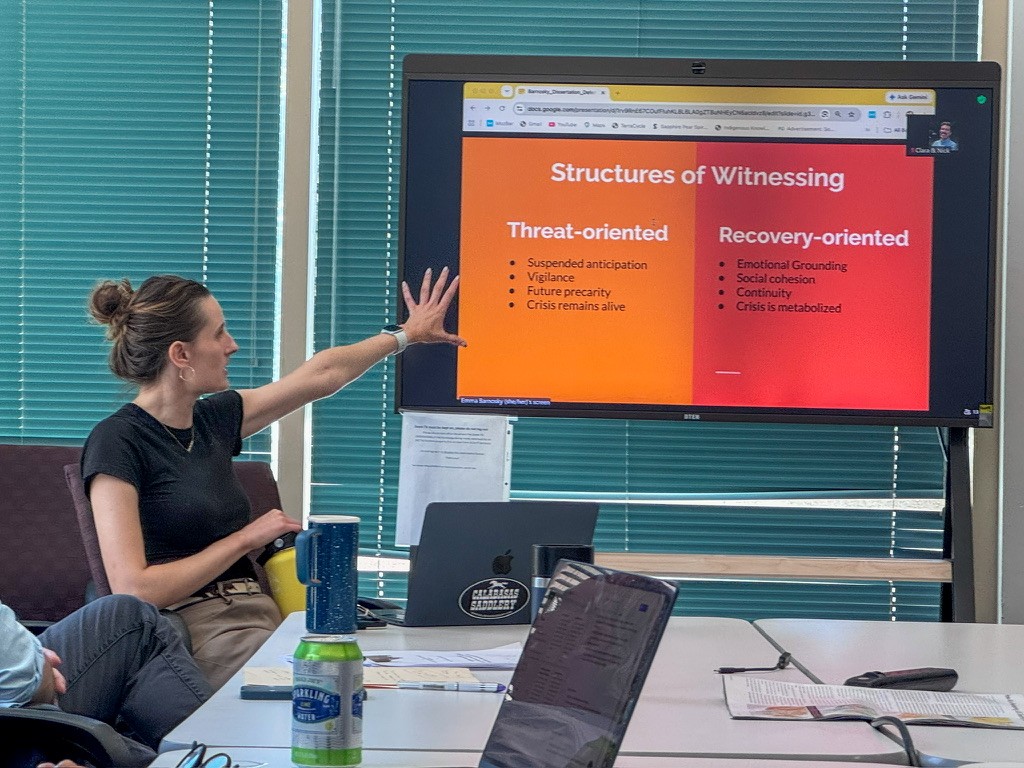
These methods together allowed Barnosky to examine both how wildfire is managed and how it is experienced.
One of her central findings was that Southern California’s long-promoted image as a place of stability and idyllic living has left residents feeling as if the carpet had been torn out from under them by the actualities of wildfire.
Through interviews with affected communities, she found that “people’s relationship and understanding of reality… was totally shattered from living through those fires.”
Yet alongside those stories of loss, Barnosky also found stories of resilience. While national reporting focused on the catastrophic effect of the fires, some local news sources, such as the Ventura County Star, also presented narratives centered on neighbors helping one another and communities rebuilding.
“Fire can serve to strengthen people together,” she said.
Research Meets Reality
The relevance of her research became all too clear as California’s latest wildfire disasters unfolded during her studies. While analyzing coverage of the 2017 Thomas fire, Barnosky watched smoke and orange light from the Palisades and Eaton fires fill the skies over Los Angeles outside her window.
This experience prompted her to revise part of her dissertation to include interviews of people affected by the most recent fires. “Fire is one of the few issues that I don’t need three slides to explain why it’s important,” Barnosky said, “because we are all living in it.”
Building Solutions Across Disciplines
She credits IoES’s interdisciplinary approach with making her research possible. Her two advisors, each from a different field, provided complementary perspectives necessary to the research Barnosky wanted to achieve.
Professor of English Ursula Heise helped shape Barnosky’s analysis of storytelling and media narratives, while Law School Professor William Boyd, whose expertise in environmental law and fire history, guided her historical and political foundations.
As a Pritzker Impact Fellow in 2021, Barnosky contributed her expertise to a wildfire innovation project that brought together researchers, policymakers, government agencies, industry leaders, and technology developers to develop roadmaps for future planning and to communicate ideas to funders and stakeholders.
Her effort as a fellow reflected the same collaborative approach in her hands-on contributions as she does in her research.
At the center of both is a simple but often overlooked question: “How are real people living real lives being impacted by the management choices that we make? And then… how does that feed back into future need for management?” Barnosky said.
Barnosky feels that her interviews with affected residents and industry leaders were the “heart of the dissertation,” which led her to be most interested in applying her expertise in trauma healing in her future work.
Ultimately, she hopes her research encourages policymakers and communities alike to remember the human experiences behind every wildfire. As California and the rest of the world continue to face the challenges of and adapt to a changing climate, “real people living real lives” should be at the heart of building the future.
Meet the Author