The forgotten places tell us the truth
2026 Pritzker Award finalist Suzanne Pierre reflects on her work
There are two ways the places my people come from are captured in popular media. In one, the terrain is paradise: turquoise water sparkles, green hills are dense with the lush biodiversity, and the absence of locals is a gnawing presence. In the other way we are represented, it is often dusty, deforested, eroded and crowded with people who look like my family. We are only visible in the second kind of image, where the landscape seems to silently confirm something about the people living on it. I understood this before I could describe it, and registered that this was a reason to feel shame — that the people and the places belong together because both are less than, with the land being more a victim to the hapless locals.
Haiti, where my father is from, has been perceived with pity and disgust from Western culture, and specifically from the sciences, for multiple centuries since an enslaved rebellion produced the first independent Black-led republic in the west. Despite sharing an island with the Dominican Republic, which receives significant scientific interest in its tropical birds and plants, Haiti’s landscapes are erroneously regarded as a cautionary tale about deforestation by locals and largely ignored by natural science fields. What has astonished me most about how scientists and society think of Haiti, if they think of it at all, is the lack of curiosity about how both ecological and sociopolitical instability may be co-produced by a single driving force. Instead, the pairing of immiserated people with seemingly degraded ecosystems has been treated as too obvious to require a mechanistic explanation. But I am unsatisfied with the flawed heuristics about hot, dusty places. I demand the mechanism. Science holds that while true randomness does exist, the world is mostly patterns waiting to be surfaced. Since I was very young, I have wanted to know how the worsening environmental conditions we see throughout the world might be shaped by the very same forces that birthed Haiti and places like it.
By the time I was a doctoral student at Cornell, I had learned to sit with the climate change elephant in the room. We measured the changes, modeled them, determined their feedbacks and interaction effects, and tip-toed around their cause without stating it. Scientific consensus held that none of what we knew of climate change had been spontaneously generated. What we were measuring in nature was caused by people, yet it was deemed unscientific to conceive of the human causes of warming as anything more specific than economic sectors, national emissions rates, and broad sources of “disturbance.” It was irrelevant to my training in soils, microbes and elements that people decided to cause ecological perturbations, that people profited from every molecule of excess carbon dioxide that entered the atmosphere, and people decided where displaced matter and energy across the planet would flow, and which communities would absorb the consequences. What I was taught instead was that history is background, social history is for another department, that rates of nitrogen and carbon being emitted from one part of the landscape and absorbed by another has nothing to do with who we are, at a fundamental level, as humans.
That boundary was not an accident of my department. Western science matured alongside colonization and industrial capitalism in the business of determining which parts of the world could be converted into wealth, and it has held its authority since by treating the physical world as something that can be measured and rooted in fact, and the social world as something fungible and loosely tied to our physical reality. To dissolve that boundary is to oblige the scientific enterprise to account for its own origins. One effect of maintaining it is that we go on studying climate change as though it were a natural experiment, an ongoing set of perturbations that yields new discoveries without requiring anyone to account for where the perturbations came from or how they connect to social, economic and political systems. That is a failure in the way science is conceived, and it originates in a Western scientific tradition built mainly in the service of economic activity and military research.
My department was never going to make the connection between power dynamics as a social force and our ecological and planetary systems. So alongside my training in isotope biogeochemistry, microbial ecology and forest ecology, I worked in social theory, critical theory, Black feminist thought and Indigenous epistemologies of nature. I did not treat those literatures as method. I treated them as explanatory models for how the dynamics of power operate within and on top of planetary systems, and I used my technical training to devise questions that could test whether their conception of power dynamics helps us better understand climate change and ecological degradation in the present and in the future. The Ecological Scars of Plantation Slavery initiative came out of those questions.
I was on track to become a professor. That was the traditional road ahead of me, and I pivoted, because building institutions is part of building a world in which these questions belong to more than one person. Reform is course correction inside a state; a complex system changes state under a perturbation. I wanted to create an intellectual home where others could conceive and test questions of this kind alongside me, so that we might generate entirely new fields of understanding of the coupled social and Earth systems. The Critical Ecology Lab is that place, and it has become a home for hundreds of thinkers within and beyond academia who want to solve the climate crisis by linking it to the crisis of global power disparities.
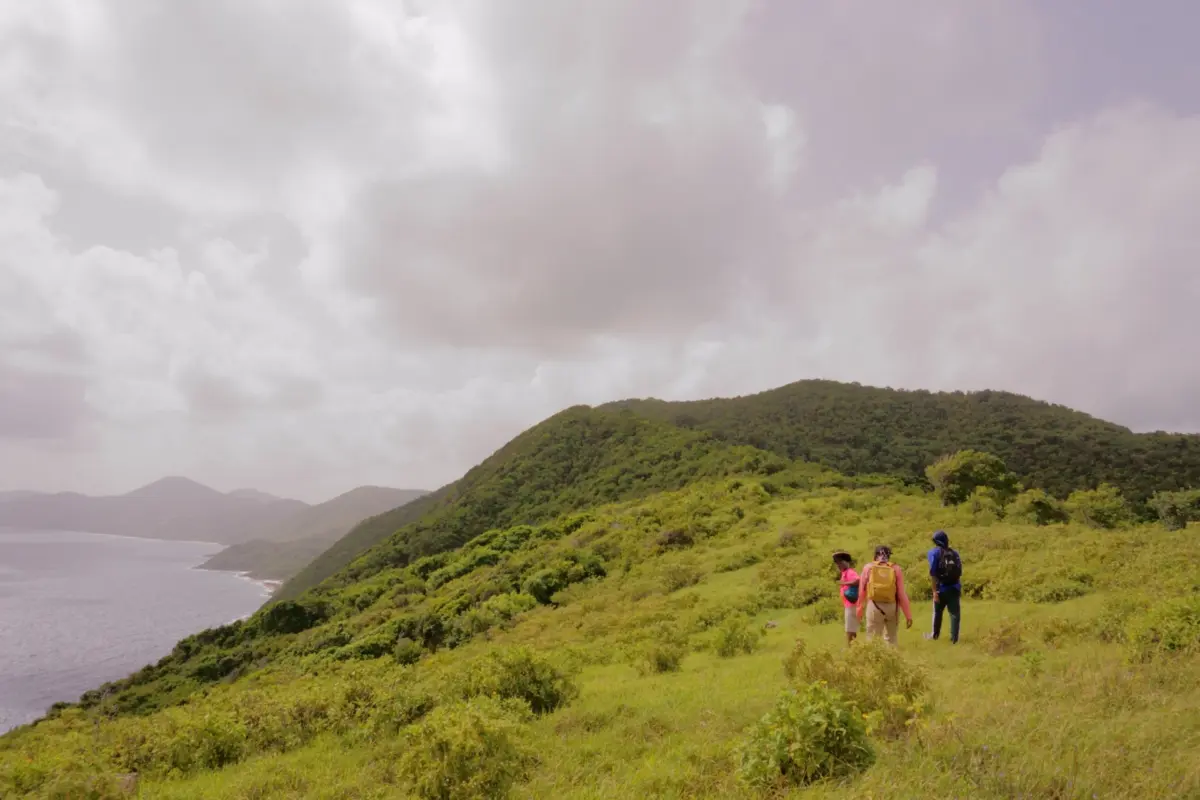
Then I went to a place where those realities are an intense and apparent part of the history. St. Croix, in the U.S. Virgin Islands, was a Danish sugar island, and the plantation impact is the first thing you see from the plane: fragmented parcels of scrubby invasive woodland, windmills standing in the fields and every place on the island named for the sugar estate that once stood there. Through experts in St. Croix, who shared the history of the island and its people with me, I watched my hypotheses meet reality, and I worked with local researchers in my team at the Critical Ecology Lab to test them. Over multiple trips and several years, we sampled 14 former Danish estates and studied how soils and vegetation respond to plantation intensity. We are finding that carbon and nitrogen stocks, soil structure, and plant functional diversity track with the intensity and duration of exploitative plantation agriculture. The few parcels the colonizers never cleared still hold more native species and more fertile soils than any other part of the island. Three centuries after the last cane harvest, the impact of exploited people and land are legible in the chemistry of the forest floor.
An individual approach to an exceptionally complex problem can look like genius, but in my case, it may be better described as the synthesis of many people’s genius, ingenuity and survival. The humility to step back and take in every place where experience and empiricism have produced essential knowledge is where genius can emerge, and even then, it is the product of a great many people’s work. While we seek forms of genius that deliver a visible impact, a quantifiable solution, a short-term KPI, the kinds of genius we need are those that potentiate alternative steady states on a planet indelibly linked to culture, history and power. We require new scientific frameworks within which impactful solutions that address the roots of the climate crises can receive support and make lasting solutions. This work, of using science and intergenerational knowledge to form and test new frameworks, is my contribution to where society might go next. If enslavement is legible in the soil carbon of one small island in the West Indies, how much more could we evidence if we for once took seriously our ability to unite scientific method with what we already know, in our bodies and across generations, about the inseparable immiseration of people and the planet?
Meet the Author