
IoES Fall 2026 Lecture: The Snail Darter and the Politics of Taxonomy
Watch the IoES Fall 2026 Lecture, "The Snail Darter and the Politics of Taxonomy," presented by Yale Professor Thomas Near.
The snail darter, a small freshwater fish, became a symbol of conservation activism after plans to build a dam in the Tennessee River Valley threatened its population in the 1970s, but new research suggests a more complicated story.
At the UCLA Institute of the Environment and Sustainability’s (IoES) Fall Lecture, Yale Professor and evolutionary biologist Thomas Near told the story of how the snail darter became a national symbol for the fight to save endangered species, and even the landmark Endangered Species Act (ESA). But, in fact, it may not have been a separate species after all.
In his opening remarks, IoES Director Alex Hall described the lecture as a “collision between rigorous scholarship and environmental decision-making,” reflecting the Institute’s goal of connecting academic research to real-world environmental challenges.
From Tiny Fish To Political Symbol
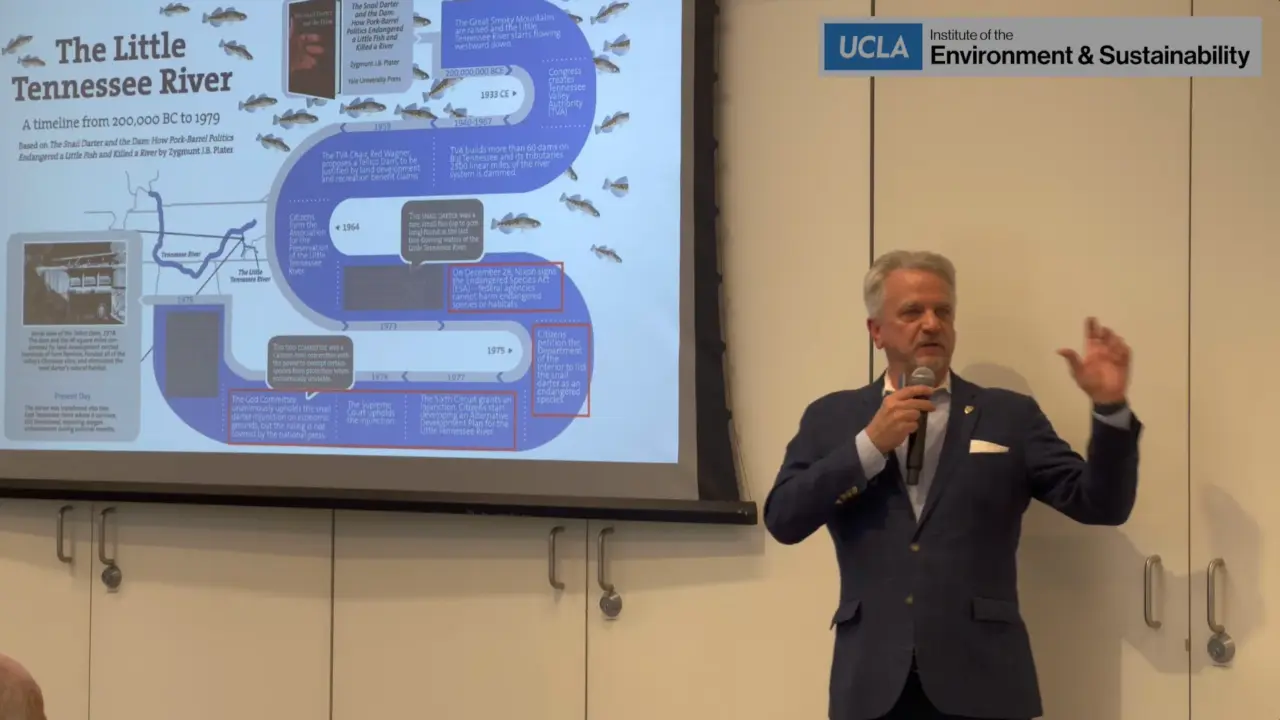
The snail darter became famous in the 1970s, when construction of the Tennessee Valley Authority’s (TVA) Tellico Dam threatened its habitat in Tennessee’s Little Tennessee River.
The dispute became the first major legal test of the ESA. In TVA v. Hill, the Supreme Court ruled in 1978 that the dam project could not proceed in violation of the snail darter’s ESA protections. And while Congress later passed an exemption in 1979, allowing the dam to be completed, the snail darter’s status as conservation movement darling was solidified.
The thing is, the snail darter may not have even been a separate species, let alone an endangered one.
Rethinking the Snail Darter
“Species are the primary unit of conservation biology,” Near said.
How scientists define species matters because those classifications help determine which organisms receive attention, resources, and which are protected by law.
Historically, scientists have relied on physical characteristics to distinguish species. Today, evolutionary research also uses genetic and genomic evidence to understand how organisms are related.
Near began investigating in 2015 whether the snail darter and the stargazing darter were actually distinct species. His research suggests they are not. Instead, the snail darter and the stargazing darter represent populations of the same species.
Despite visual differences, “Percina tanasi, the snail darter, is a taxonomic synonym for Percina uranidea, the stargazing darter. So in a sense, the snail darter does not exist,” Near said.
Near emphasized that his lecture was not meant to argue against the ESA. Rather, he wanted to show that the science behind species classification can become entangled with political and conservation goals.
Near acknowledged that the fish represented a way to fight the TVA, saying it “was a noble thing to fight,” but he raised concerns about the “conservation species concept,” the idea that a population might be considered a distinct species to help secure conservation protections.
The challenge is balancing the urgency of protecting biodiversity with the need for accurate scientific conclusions.
“We should get the science right; [we should] follow the science from the beginning,” Near said.
Following the Science
To further show how proper identification can advance conservation, Near discussed his research on the Birmingham darter, a small fish found in a limited area near Bessemer, Alabama.
The species became a local concern as Meta proposed a data center near its distribution. Community members contacted Near to better understand the fish and the development’s potential implications.
Near’s research gave the residents the scientific information to bring into conversations about protecting their local habitat. The Center for Biological Diversity also petitioned the federal government to consider the Birmingham Darter for protection.
“This work is empowering people to push back, to be proud of the biodiversity in their part of the world,” Near said.
Near also warned that without proper identification, many species will likely disappear without anyone even knowing.
“There’s a tragedy that we’re losing species that have never been identified,” he said.