
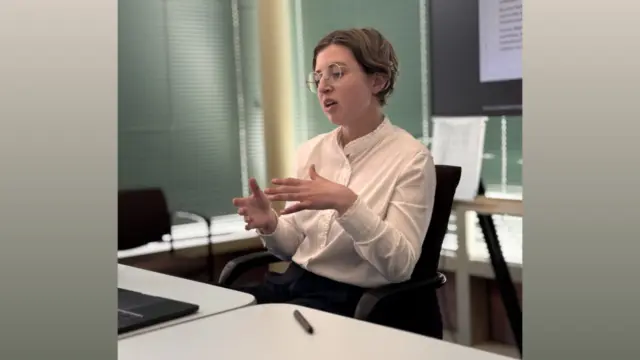
D.Env. Graduate Spotlight: Madeleine Siegel on Building Trust in Sustainability Solutions and Infrastructure
As cities face growing climate challenges, designing effective infrastructure requires more than technical expertise; it also means understanding how people experience environmental change in their daily lives. Madeleine Siegel examines how these community perspectives can help shape climate solutions.
In June, Siegel successfully completed her dissertation in the IoES’s Environmental Science and Engineering professional doctorate (D.Env.) program, under her advisor, Professor of Law and Director of the UCLA Sustainable Technology and Policy Program, Timothy Malloy.
Her dissertation is built around a simple but important idea: people who live in and actively engage with climate solutions have knowledge that engineers and other technical experts may not. Although incorporating community perspectives improves technical performance, the value of this approach extends far beyond that.
When communities have a meaningful role in shaping projects that affect them, they are more likely to trust those projects, strengthening the long-term support climate infrastructure needs to succeed.
A path to practical research
Siegel’s path to her doctoral research prepared her well for interdisciplinary work. After her undergrad years at UC Berkeley majoring in Conservation and Resource Studies, with a focus on soil science and sustainable agriculture, she completed an internship at the United Nations Educational, Scientific and Cultural Organization (UNESCO), where her work focused on STEM education for girls with limited access.
It was her boss at that internship who encouraged Siegel to pursue a master’s degree.
Along the way, she also worked at the New York State Attorney General’s Office, the Sabin Center for Climate Change Law at Columbia Law School, and served as a project manager building multi-acre rooftop farms in New York City.
“Those really on-the-ground jobs kept me wanting to have a more tangible focus to the research that I do,” she said.
That same pull led her to pursue a doctorate at IoES, where she was drawn to how grounded the program felt, with students bringing real-world positions and work experience directly into their dissertations. “I really appreciate research that has a practical lens,” she said.
The common thread that runs through Siegel’s work is “to put science into action, try to protect the environment and communities who are facing environmental harms,” she explains. She sees academia’s role as building the evidence base, but she is more interested in what happens next. How does research translate into decisions that affect people’s lives, and how can we use research to make solutions that last?
Centering lived experience
As a result, her dissertation focuses on how to ensure community members’ lived experiences genuinely shape sustainable development, and why that matters.
Much of the conversation around nature-based and sustainable infrastructure tends to be technical, asking only how well it performs. Siegel’s research pushes that conversation toward the social dimension of these projects.
“We are very interdependent with our environment,” she said.
Communities aren’t separate from the infrastructure and environment around them. Environmental infrastructure shapes daily life in direct, concrete ways, and the people who live within it carry knowledge that won’t show up on models.
Residents know which intersections flood first. They know what extreme heat actually feels like on the block. They know which streets are hardest to walk down to catch the bus. Siegel points to something that research has increasingly shown: when local knowledge is incorporated, infrastructure performs better.
“Everyone deserves a voice in terms of shaping infrastructure projects in their neighborhoods,” she said.
Listening on the ground
To surface that knowledge in her dissertation, Siegel spoke directly with community groups across Los Angeles and ran surveys across California to gather opinions on the effectiveness of different climate solutions.
Siegel found that listening to on-the-ground perspectives makes an infrastructure project more effective, inclusive, and resilient. In Los Angeles, she found that people took part because of their connections with neighbors and their attachment to place, even when they didn’t see themselves as environmentalists. When people have a real say, they trust the work and feel a sense of ownership, which helps it last.
Applying these same methods to ocean-based solutions, Siegel also led a parallel project on kelp forest restoration, interviewing kelp farmers and marine field workers across California to help identify restoration strategies that can be adapted worldwide.
After defending her dissertation, Madeleine Siegel plans to “stay in the space that brings science and policy together,” with an eye toward continuing science communication and writing alongside her policy work.