
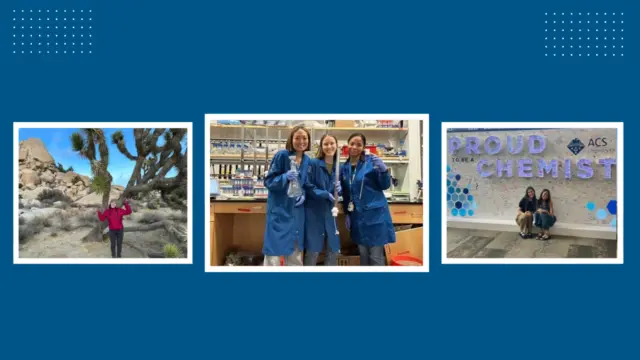
Irena Pavlovic Finds Her Fit in UCLA’s Environmental Science and Engineering Program
When Irena Pavlovic arrived at UCLA, she knew she wanted to tackle environmental problems through research, but found the traditional Ph.D. path wasn’t the right fit.
With her wide-ranging interests, she wanted the freedom to explore. Finding the UCLA Institute of the Environment and Sustainability’s Doctor of Environmental Science and Engineering (ESE) Program gave her the flexibility and support to pursue research she never thought possible.
Pavlovic is a fifth-year student in the ESE Program. She works with Sanjay Mohanty, Professor of Civil and Environmental Engineering, studying how pollutants move through aquatic and atmospheric systems.
“The traditional academic field, and academia as a whole, really needs more support for these types of programs.”
Irena Pavlovic
While she has covered a wide range of pollutants and their effects on human and environmental health, her current focus is contaminants of emerging concern, such as PFAS (synthetic or “forever chemicals”), microplastics, and wildfires. Pavlovic wants to know how these pollutants move through different systems and the sprawl of effects they have. She also wants to keep cross-disciplinary participation central to her work.
Her research doesn’t sit neatly within one discipline, and she says that’s the point.
“Being a part of these different labs where I traditionally wouldn’t fit into has really helped shape my research directions,” she said.
The ESE program allows her to do that.
Finding the Right Fit
Pavlovic came to California to pursue environmental work, with a background in public health and toxicology. She first planned to pursue a traditional Ph.D. at UCLA, but found it wasn’t the right fit.
Then she learned about the IoES’s ESE program, which offered both interdisciplinary, applied research and the freedom for innovation she had been looking for.
The ESE program is built to encourage broader research interests and applicability across fields of study. The program lets her combine academic research with practical engagement across industry, government, nonprofits, and communities. Pavlovic can pursue these through any pathway she chooses, stay creative, and avoid feeling confined to a single box.
“I’ve kind of surprised myself in actually being involved in the projects that I had dreamed I would do, but I never thought I would do five years in,” she said.
For Pavlovic, the type of support is really what enabled this success and sets the program apart.
“You have faculty that are supportive of the interdisciplinary work. You have a whole department that is supportive, and you have a program that exists literally for that,” she said.
Stronger Research Through Diverse Ideas
Her ESE peers work on coastal rehabilitation, wildfires, atmospheric sciences, healthcare, green energy, sustainability reporting, and life-cycle assessments, using methods from data analysis to laboratory and fieldwork.
At first, that range was intimidating, since many of the subject areas were unfamiliar to her. Now she sees it as a major advantage. Alongside mutual support, engaging with colleagues outside her own specialty has sharpened her research and helped her communicate it more clearly.
Pavlovic’s experience shows that research can be academically rigorous while staying relevant to a wide range of stakeholders and practical environmental challenges. In her view, the biggest breakthroughs come from collaboration.
“I think what really can address any challenge is when you get people from these different fields together in one room to work together,” she said.
More Questions and Wider Impact
After five years, Pavlovic finds herself asking more questions than when she began. Each project opens new questions and new opportunities to collaborate, and what began as a narrow research interest has grown into a broader curiosity about environmental problems and their solutions.
She currently works for the government and hopes her work will lead to publications, and a career bridging her current role and academia.
“I’d really like to inspire newer students to pursue any of their research interests and know that it doesn’t have to fit into a specific box,” she said.
Pavlovic’s own path shows what becomes possible when a program makes room for it: she followed her questions across disciplines, learned from peers outside her specialty, and carried her research into communities. Her larger goal is to make interdisciplinary research more accessible and collaboration more common.
“The traditional academic field, and academia as a whole, really needs more support for these types of programs,” she said.