Where I [Vik Jolly, author] live in Riverside County, in the shadow of the Santa Ana Mountains, we haven’t seen snowy hillsides for nearly a decade. But there’s a good…
A new initiative of the UCLA Sustainable LA Grand Challenge intends to bring UCLA scholars together with community stakeholders to address a rotating list of four key topics related to sustainability: transportation,…
“The mountains certainly will see significant snowfall. The deserts and some of the highest inland valleys might even see a little bit of flurries, although accumulation is less likely,” added…
“Nearly the entire population of CA will be able to see snow from some vantage point later this week if they look in the right direction (i.e., toward the highest…
“This is shaping up to be a very unusual event,” UCLA climate scientist Daniel Swain said in a virtual briefing Tuesday morning. “We are going to see low [elevation] snow all…
About 150 people die every day in L.A. County during the summertime, but during an extreme heat event the deaths increase by 8% to 30%, according to Edith de Guzman,…
“Hopefully the memory of what happened at Oroville is not lost on people’s minds,” he said, referencing the 2017 crisis in which high water levels nearly overtopped the massive Oroville Dam.…
A new study led by the University of California, Los Angeles (UCLA) has found that global atmospheric dust (microscopic airborne particles from desert dust storms) has a small, yet significant cooling effect on our…
Erik Porse joined the University of California Agriculture and Natural Resources on Jan. 11 as director of the California Institute for Water Resources.
”We are on the express train for sure. It’s been storm after storm. But they’re very important, the main source of moisture for the western part of the US especially…
These wet-air rivers are “the main source for moisture for the western part of the U.S., especially the coastal states,” Alex Hall, UCLA’s Center for Climate Science director, told CBS.
A new paper by UCLA ecologists explores one reason: disturbances to Earth’s magnetic field can lead birds astray — a phenomenon scientists call “vagrancy” — even in perfect weather, and…
“My goal is to map glaring hot spots of genetic diversity,” said Brad Shaffer, an evolutionary biologist at UCLA who has devoted more than a decade to the cause of conserving assemblages of life forms with the greatest likelihood of adapting to future climate conditions.
Now, as director of UCLA’s La Kretz Center for California Conservation Science, he leads a team of 114 researchers drawn from all 10 University of California campuses that is creating the most comprehensive genomic dataset of native species ever assembled for conservation science.
The negative effects of sulfur dioxide emissions into the atmosphere include the potential for ozone layer destruction, respiratory disease, and acid rain. But according to UCLA environmental law expert Edward…
“eDNA is a really powerful tool for providing insights into the plants and animals inhabiting an ecosystem,” said Paul Barber, a UCLA professor of ecology and evolutionary biology, member of…
In the new documentary Without Water, Stephanie Pincetl, director of the California Center for Sustainable Communities at UCLA, argues that Long Valley is a test case for big cities seeking smarter ways…
“It’s only through studies like this that focus on how animals perceive and react to the stimuli in their environment—which can either attract them or repel them—that we’ll gain the…
The California Conservation Genomics Project (CCGP) is a unique, critically important step forward in the use of comprehensive landscape genetic data to modernize natural resource management at a regional scale. This dedicated issue of the JOH contains 17 CCGP papers, including the Editor's Choice lead article by La Kretz Center Director Brad Shaffer and the CCGP Executive Committee describing the project inception, goals, and deliverables.
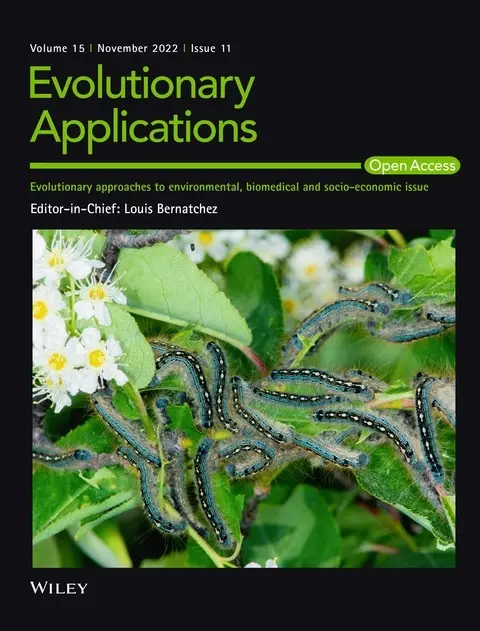
The article authored by La Kretz postdoc Zac MacDonald concludes that ecologically mediated selection is contributing to variation within forest tent caterpillars (M. disstria), and that divergent adaptation related to both environmental conditions and host association should be considered in ongoing research and management of this important forest pest.